Site traffic doesn’t tell the full story of your visibility
For years, ranking well and getting clicks were closely tied. If your page ranked, someone visited your site, and you could measure that visibility directly in your traffic numbers.
That's no longer the case. People can now learn about your institution, compare programs, and begin forming decisions without ever landing on your domain. While visibility still matters tremendously, we can’t rely as heavily on traffic to tell us whether we’re visible.
The competition isn’t solely focused on rank. It’s about being included in an answer, understood correctly by AI systems, and ultimately trusted enough to influence a decision. The question has evolved from only “Where do we rank?” to “Where does our institution actually show up when people are looking for answers?”
Discovery has become more conversational, contextual, and synthesized, with important implications for how institutions create and structure content.
AI is Changing How Information Gets Discovered and Evaluated
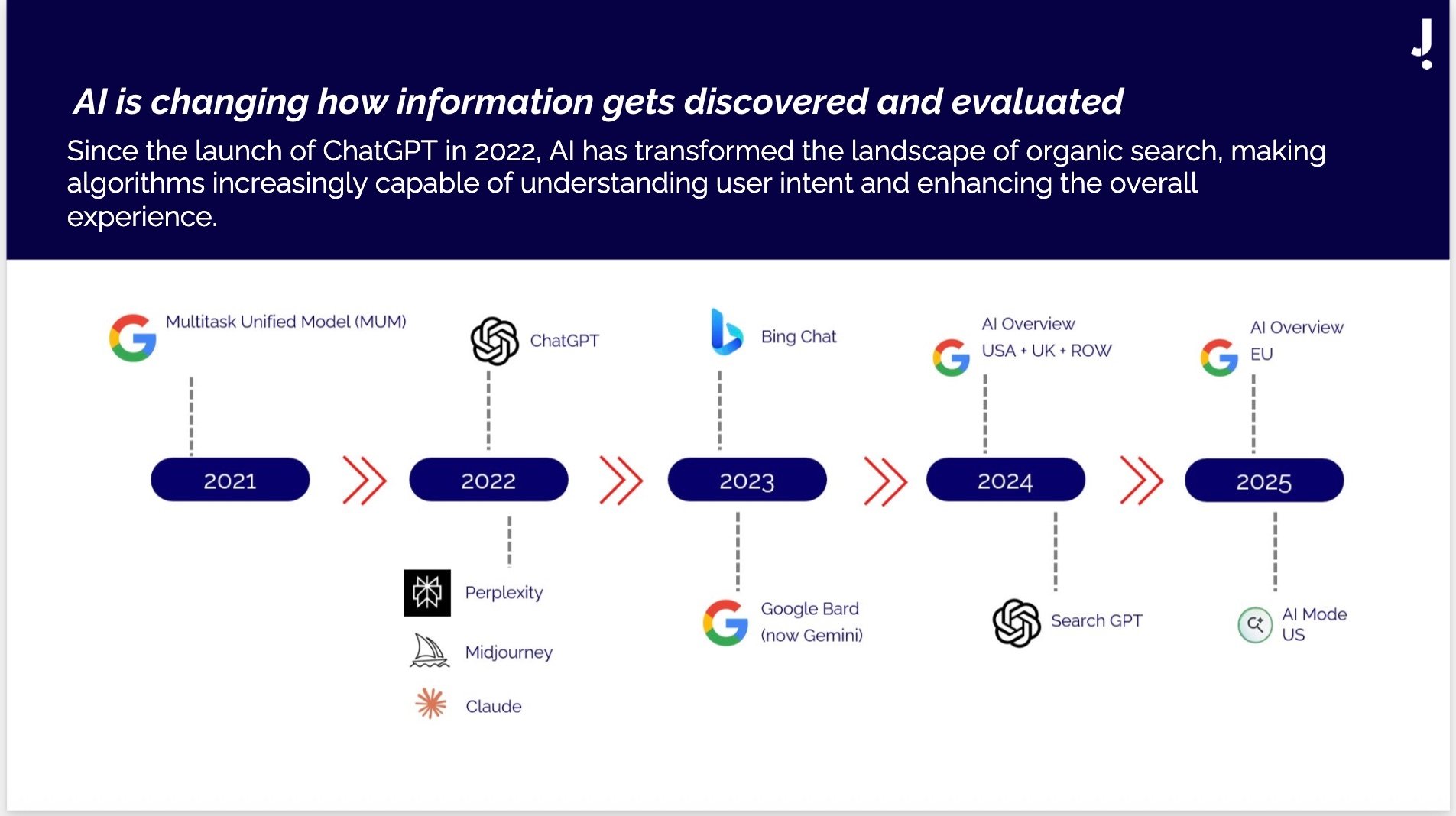
Since the launch of ChatGPT in 2022, AI has transformed the landscape of organic search, making algorithms increasingly capable of understanding user intent and enhancing the overall experience.
Many AI tools and systems have entered the market since ChatGPT, and what’s changed broadly has been how users interact with information. Instead of a search engine producing 10 links and having the user figure out which ones to click, AI-powered experiences can interpret information from multiple sources and synthesize it into an answer.
This timeline shows the progression from traditional search towards multiple AI assisted discovery interfaces within the last five years.
Discovery itself has become increasingly fragmented. Prospective students aren't only searching Google. They're also using platforms like TikTok, YouTube, Reddit, and using AI chatbots. They're going to special publications, communities, and all of these other sources rather than coming to the website for the main source of information.
That impacts content strategy because we can't respond by creating a completely separate strategy for every new interface that students use. We don’t know what the next interface will be. Instead, institutions need information that is structured clearly enough to travel across channels and experiences.
Another major change will be around what students are asking overall. Traditional search has trained us to condense what we’re looking for into keywords to find the right thing. Now it’s a conversation. Students can explain their exact situation, what matters to them, what they’ve already considered, and ask very nuanced questions to get that answer they’re looking for. And importantly, they might get a good answer without clicking anywhere.
As the search questions become more complex, the answer is ensuring we have clear, more connected information across our sites that allow these systems to understand that full picture.
We spent decades optimizing for search engines, and now we’re optimizing for answer engines.
-Mandee Englert
More content doesn’t mean more authority
AI has made it easy to produce content: more blog posts, more FAQs, more landing pages. But ease of production doesn’t equate to earning authority. Publishing 100 articles about financial aid doesn't make you the most trusted source on financial aid.
In practice, overproducing content often backfires. Institutions can end up with duplicated pages that all say roughly the same thing, scattering expertise across multiple mediocre resources instead of concentrating it on one strong, well-connected source. Plus, every page published requires ongoing maintenance to stay accurate and current, or it risks becoming stale noise.
In her work with large higher education websites, Englert has encountered ecosystems containing 8,000 to 10,000 pages where content audits ultimately identified only around 3,000 pages worth retaining. The rest often reflected duplication, outdated information, or content that could be consolidated into stronger authoritative sources.
The search experience is changing. The foundational principles are not.
The good news? We don't have to throw away everything we know about content strategy and SEO. Though the user experience is evolving, the underlying principles are the same. Search engines are still trying to identify which answer is the most useful and trustworthy. Our objective: when a user asks a question we can credibly answer, our answer has the best opportunity to surface.
AI exposes underlying content problems.
For many institutions, AI isn't creating a new content problem as much as exposing an existing consistency problem. Universities often manage content across multiple domains, teams, platforms, and organizational units, sometimes describing the same programs, services, or topics in different ways. People may understand the organizational reasons behind those differences. AI systems see disconnected signals.
That means AI can amplify the consequences of fragmented content, inconsistent messaging, and disconnected structures that may have existed for years.
SEO, AEO, GEO share the same foundation
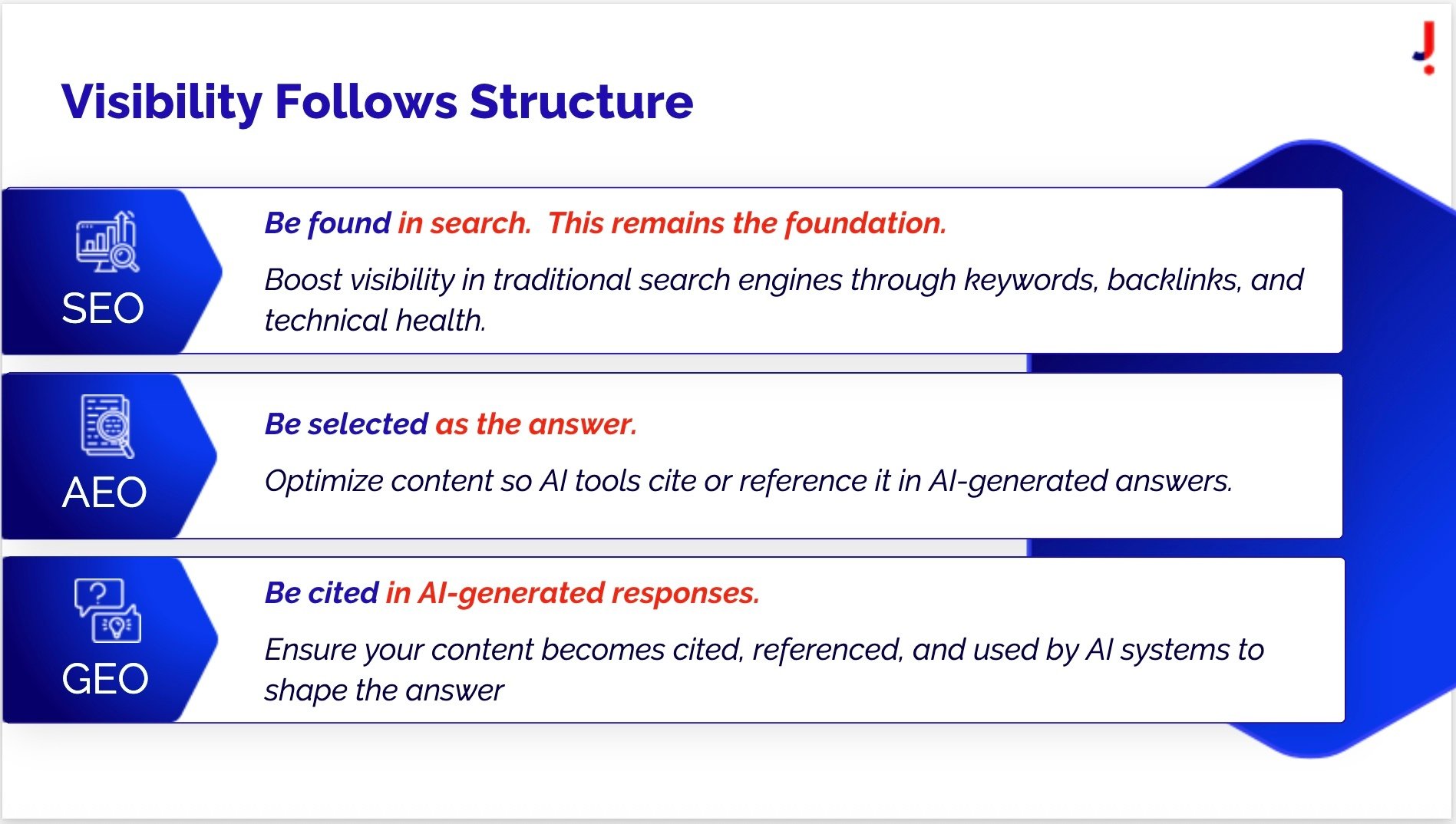
SEO, AEO, and GEO don’t require three completely separate strategies, as they’re increasingly dependent on the same foundation of clear, structured, and authoritative information.
Overall, SEO is still going to be your ultimate foundation for being found in search. AEO asks whether our content can actually be selected for the answer, and the generative search takes that another step: can our information be cited, referenced, and incorporated into a generated response?






.png?width=600&height=793&name=Challenges%20of%20Centralization%20(General).png)