Voices

What is AI saying about your brand?

5 min read

Published on January 13, 2026

What is AI saying about your brand?
This insight is shared by Lotus Child, Director of Digital Experience at JAKALA.

Why brand authority is increasingly mediated by systems you don't own, and what you need to do about it.

A prospect arrives at a sales call already convinced your competitor is the category leader. Your team asks where they heard that. The answer: "I asked AI." No article. No analyst report. Just a confident, synthesised answer from a system that has never spoken to your brand team—and now speaks for you.

This is happening now, across industries, at scale. Most organisations still believe they control how their brand is discovered and evaluated. That assumption is broken.

Customers no longer form opinions by visiting websites or comparing content. They ask AI to do that work for them, introducing a powerful intermediary between themselves and the brands they choose.

In short…

AI systems now interpret, summarise, and recommend brands before a human ever engages directly—invisibly shaping perception at scale.

The implication is huge: brand control is no longer exercised solely through owned channels or campaigns. It is increasingly mediated by systems you do not own, trained on signals you may not fully understand, and optimised for outcomes that may not align with your intent.

The question is no longer whether AI will influence how your brand is perceived but whether you are actively shaping that influence, or passively inheriting it.

The Authority Window Is Closing

AI systems are still forming their understanding of category leadership. They're learning which brands to cite, which voices to trust, and which sources to dismiss. This is not a permanent state, though, it's a window. And it's narrowing.

Early positioning in AI models compounds. Brands that establish authority now shape how their category is defined—not just how they compete within it. They become the reference point against which others are measured.

Those who wait will find themselves responding to a narrative they didn't write, cited alongside sources they didn't choose, and summarised in ways they can't control.

Authority established early is defended easily. Authority earned late is expensive.

From Search Results to Silent Spokesperson

Search engines once helped customers find information. Then they helped them compare it. Today, AI systems are doing something far more consequential: they are helping customers decide.

Instead of scanning multiple sources, users ask a single question and receive a synthesised answer. That answer often includes recommendations, trade-offs, and next steps—and perhaps most importantly, is trusted without further validation. The AI has effectively become your silent spokesperson, representing your brand before you ever have a chance to speak.

This matters because brands are no longer competing for attention on a results page. They are competing to be understood correctly by an algorithm that will speak on their behalf. And that algorithm doesn’t care about brand intent, only about the signals it can interpret.

zulfugar-karimov-CaRba5ZXJTQ-unsplash

Visibility Is Table Stakes. Authority Is the Game.

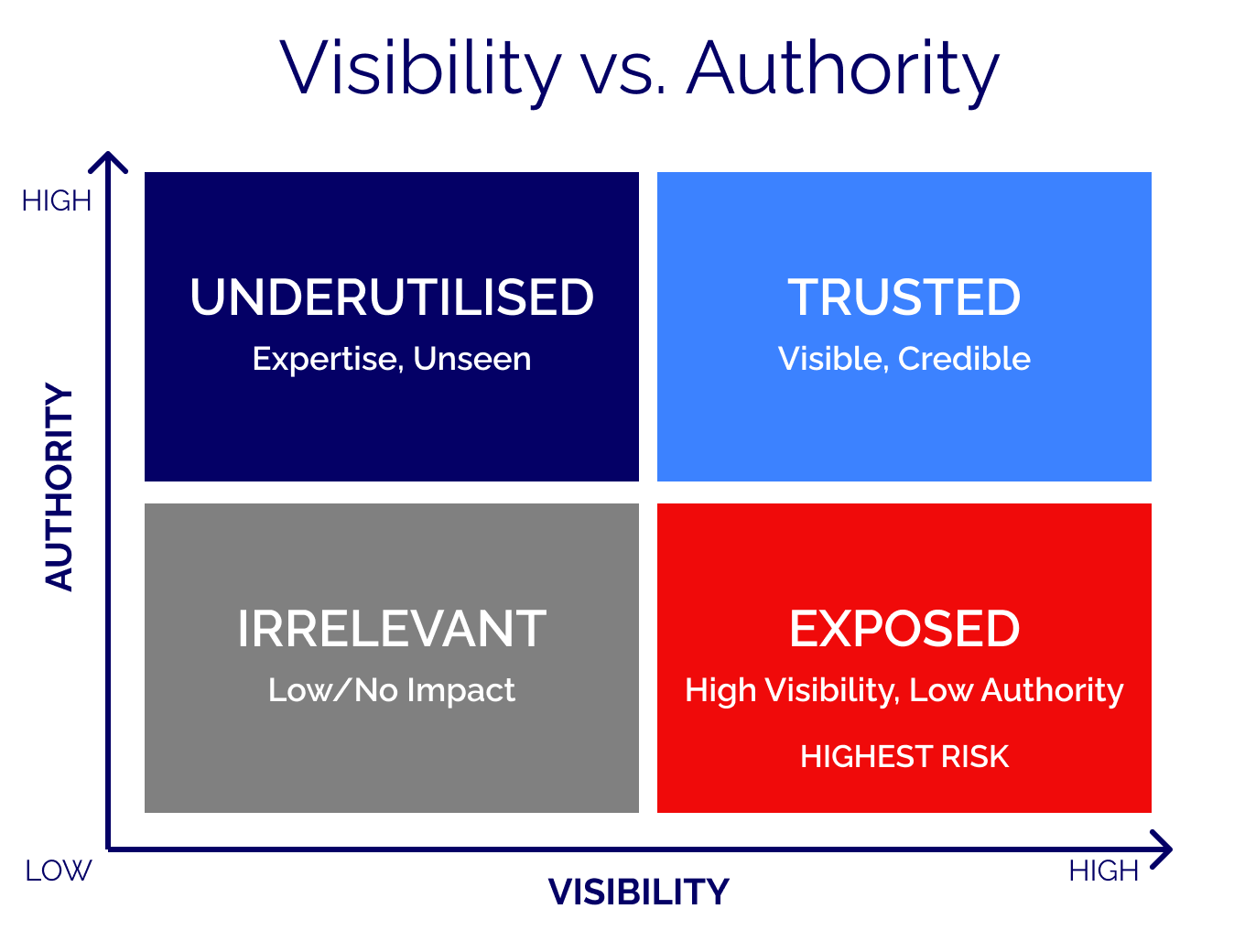
Traditional metrics—rankings, traffic, clicks—measure exposure. But AI doesn't optimise for clicks. It optimises for confidence. It cites brands that demonstrate depth, consistency, and clear expertise within a domain.

AI systems prioritise sources that clearly articulate what they know, what they do best, and where they lead. They reward brands that make expertise explicit, not assumed.

You can be highly visible and still lose authority—and authority loss happens before it shows up in your dashboards. By the time traditional KPIs decline, AI has already chosen your competitors as the safer, clearer answer.

Being visible without being authoritative is not neutral. It is a liability.
Visibility vs. Authority

How AI Decides What Your Brand Means 

AI doesn't experience your brand the way people do. It doesn't intuit nuance or absorb tone. It pattern-matches: structure, repetition, corroboration, and clarity across dozens of sources it finds, and weighs without your input.

Yes, it pulls from your website, but also from forums, review sites, archived PDFs, LinkedIn posts, and third-party think pieces written three years ago by someone who misunderstood your pivot. It compresses all of this into a single, confident answer that sounds authoritative even when the underlying sources are partial, contradictory, or outdated.

Example: Ask AI to compare enterprise data platforms, and you might find your brand described using positioning you retired two years ago because that language still dominates the corpus. Meanwhile, a competitor who invested in structured, AI-readable content has quietly claimed the language you invented.

If your expertise is implied rather than stated, it may be missed. If your positioning is fragmented across regions or teams, that fragmentation is amplified. And if you leave gaps, AI will fill them—often using sources you would never choose as your brand's representative.

AI doesn't ask what you meant. It infers what you've proven.

When AI Gets It Wrong, It Gets It Wrong at Scale

For large, global organisations, the real risk is not invisibility; it is misrepresentation.

AI systems do not guarantee consistency across markets, languages, or contexts. They may surface different interpretations of the same brand depending on geography, query phrasing, or data availability. Legacy content, outdated positioning, or niche third-party opinions can suddenly carry disproportionate weight.

The result is not a one-off error, but systemic misinterpretation—repeated, amplified, and scaled across thousands of interactions.

This kind of brand drift rarely triggers alarms internally. Yet it quietly reshapes how customers, partners, and even employees understand what a company stands for.

Your Organisation Wasn't Built for This

Most enterprise content and brand governance models were designed for a world where:

  • Humans browsed websites and read pages in sequence
  • Brand consistency meant visual guidelines and approved messaging
  • Content could be gated, updated quarterly, and reviewed by legal before publication

AI breaks all of these assumptions. It synthesises across silos. It interprets intent from structure, not from what you meant to say. It operates 24/7 in every language, pulling from sources you may not even track.

The gap between how enterprises produce brand content and how AI consumes it is widening—and it's structural, not tactical. You can't governance-committee your way out of this. You need systems that operate at AI speed, not meeting cadence.

This is not a failure of effort or intent. It is a mismatch between how organisations work and how AI interprets information.

You Can't Govern What You Can't See

Owning brand authority in an AI-mediated world does not mean chasing every new tool or trend. It starts with visibility: understanding how AI systems currently describe your brand, which sources they rely on, and where inconsistencies appear.

From there, it requires deliberate action:

  • Making expertise explicit rather than assumed
  • Designing content to be interpreted accurately, not just consumed
  • Embedding brand wisdom into scalable systems so it travels consistently across markets and use cases

Humans still matter, deeply. But their role must shift from manual production to strategic oversight, judgment, and calibration. The goal is not to remove people from the loop, but to stop them from being the bottleneck.

Brand Is No Longer Just Expressed. It's Interpreted.

Traditionally, brand has been something organisations express: through campaigns, messaging, and experiences. In the AI era, brand is increasingly something that is interpreted by machines.

AI reads structure, clarity, and consistency. It forms opinions based on how well a brand defines its expertise, boundaries, and perspective. In that sense, your content ecosystem is no longer just a marketing asset—it is part of your brand infrastructure.

If your brand is not designed to be interpreted correctly by machines, it won't be.

The Choice You Have

If AI is increasingly speaking for your brand—interpreting your expertise, summarising your value, and guiding customer decisions—you face a choice:

Own the relationship. Invest in making your brand legible, consistent, and authoritative to the systems that now mediate perception.

Or inherit the interpretation. Accept that your brand will be defined by whatever signals AI finds easiest to pattern-match—even if they're partial, outdated, or shaped by competitors who moved faster.

This is not a question of marketing tactics. It's a question of strategic control.

Authority, established early, compounds. Authority, earned late, is expensive.

The window is open. It will not stay that way.

Final thoughts

Checklist: Is AI Already Speaking for Your Brand?

You don't need to guess whether this shift affects you. If three or more of these are true, AI is already shaping your brand perception:

☐ Prospects arrive with specific assumptions about your capabilities that don't match your current messaging

☐ Sales teams hear "I was told you're best at X" but can't trace the source

☐ Different regions report inconsistent brand perceptions despite shared guidelines

☐ Low-quality or outdated third-party content appears when AI summarises your brand

☐ You're seeing traffic from AI tools, but attribution is opaque

Critical test: Your executive team can't confidently answer: "How does ChatGPT currently describe us?"

If you checked 3+: AI is already interpreting your brand. The question isn't whether to act—it's whether you're willing to act while you still have influence.

If you can't see it, you can't govern it.

Learn more about how JAKALA helps businesses develop their technological capabilities,
with our multidisciplinary, data-driven approach.

Want to discuss?

Lotus Child

Lotus Child

Director of Digital Experience at JAKALA UK, France, Nordics.

Let's talk

Curious about how we can help
you with your projects? 

Reach out to us to have a conversation for your specific needs. 

Insights

JAKALA enhances ZDF’s streaming platform with live sports experiences ahead of the Winter Olympics
Article

JAKALA enhances ZDF’s streaming platform with live sports experiences ahead of the Winter Olympics

3 min read
JAKALA Achieves Adobe Journey Optimizer Specialization
Article

JAKALA Achieves Adobe Journey Optimizer Specialization

3 min read
 Lauren Sallata is the new Chief Growth Officer of JAKALA North America
Article

Lauren Sallata is the new Chief Growth Officer of JAKALA North America

3 min read
Retail Media Off-Site: Toward an Omnichannel, Measurable, and Scalable Attribution Model
Article

Retail Media Off-Site: Toward an Omnichannel, Measurable, and Scalable Attribution Model

4 min read