

Article

Is Your University's Authority Retrievable, or Only Readable?

4 min read

Published on November 16, 2026

Solutions: Sales & Marketing Cost Optimization, DXP – Digital Experience Platforms, Business Intelligence & Data Visualization
Is Your University's Authority Retrievable, or Only Readable?
DD2026-Promo-Schedule-Ray-Saltini (1)

Author's Note: This post is adapted from JAKALA North America's Senior Director of CX Solutions & Partnerships, Ray Saltini's featured presentation at Decoupled Days 2026 in Montréal, "Mental Models for Discovery in Modern Composable Architectures."


What Worked Yesterday Doesn't Work Today

For twenty years, the page was the unit of search. A university picked its keywords, built program pages, earned links and fought for position on a list of results. Success was a click.


That model no longer works on its own. A prospective student asks an AI system which schools are strongest in climate science. A faculty candidate asks who leads in quantum research. A foundation officer asks which institutes work on a problem she wants to fund. Each gets an answer assembled from many sources, often without visiting any of them. The objective has changed. You are no longer trying to rank for the click. You are trying to be the source an AI system trusts enough to cite.


That is generative engine optimization, or GEO. The strategic unit is no longer the page. It is structured knowledge: the programs, people, research and facts your institution publishes, in a form a machine can read, reconcile and repeat.

You can be right on your site and wrong in the answer

An AI engine doesn't read your website the way a visitor does. It assembles an answer from everything it can find: your central site, your school and department sites, faculty profiles, rankings, application platforms, directories, press coverage and the PDFs nobody remembers posting. When those sources disagree, it resolves the conflict by guessing. When it guesses, you are left out or misrepresented.


There is no notification when that happens. No ranking report shows that an AI answer left your program off a shortlist, or described your research as it stood five years ago. For enrollment, faculty recruitment and research partnerships, that silence is the risk.

The contradictions start inside the university

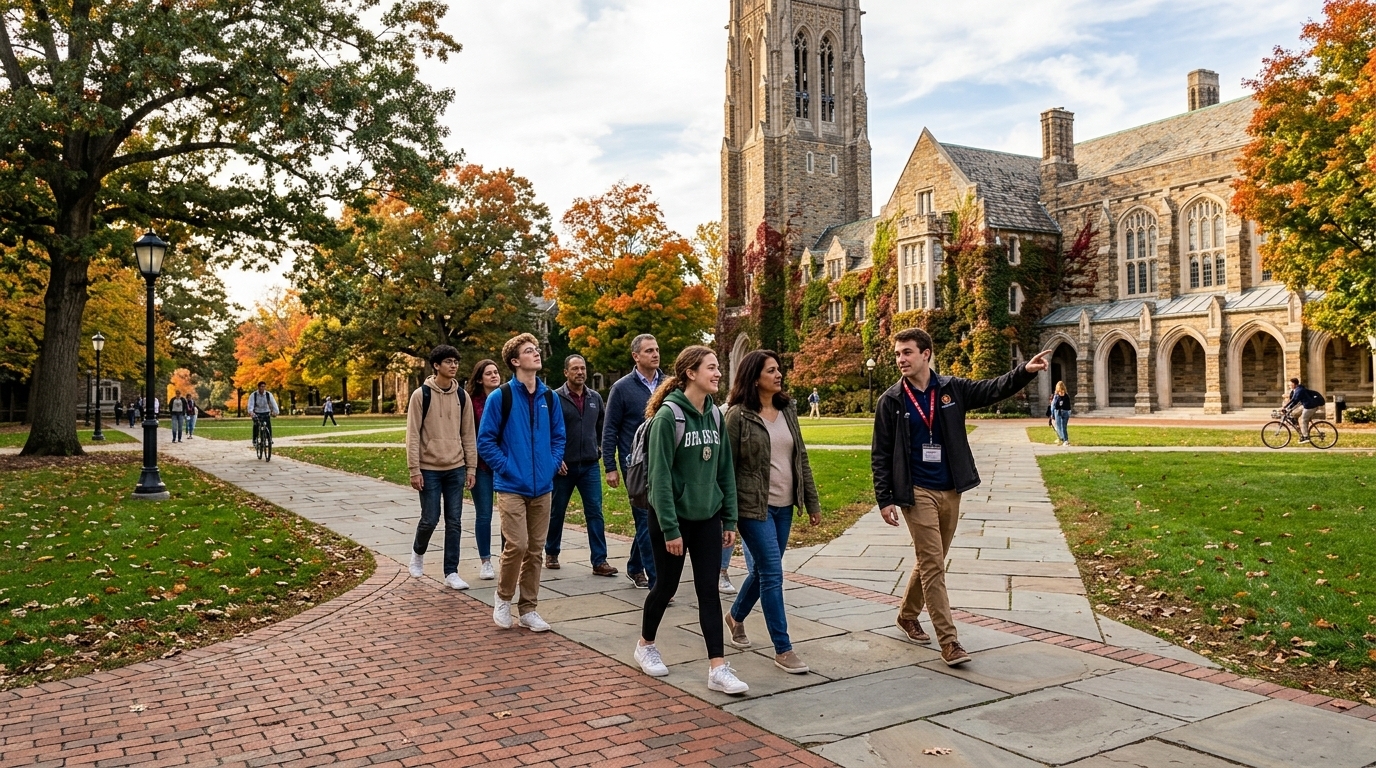
In most sectors, the inconsistency lives out on third-party sites. In higher education it starts at home. A university may run hundreds of sites, owned by schools, departments, centers and offices that each publish their own version of the facts. Application deadlines differ between the admissions site and the department page. A program's length changes in one place and not another. A faculty member's bio on the school site is three years older than the one on the lab site.


A person can usually work out which version is current. An AI engine can't. It sees a university that contradicts itself, and it either guesses or looks elsewhere.


That makes governance across a decentralized estate a discoverability problem, not only a brand or web team problem. The question is the same one every web leader already asks: who owns this fact, and where is the one canonical version of it?


Authority is not the same as retrievability

Universities have more authority than almost any other kind of organization. The problem is where it lives. Decades of expertise sit in faculty CVs, research reports, conference papers and news stories written as prose. Readers can find it. Machines often can't reach it or can't parse it.

That is why we separate content strategy from retrieval strategy. Content strategy asks whether your audience will read something. Retrieval strategy asks whether an AI engine will cite it when your audience asks the question. Good research storytelling still matters: start with something relatable and layer in the depth. Retrieval strategy makes sure the facts underneath that story are structured, so the story and the citation agree.


Model the people and the research

The most valuable structured knowledge a university has is its people and their work. When faculty profiles, publications, research areas, institutes, programs and media mentions are modeled as content types with clear relationships, rather than written into pages, they become something an AI engine can read and cite. A faculty directory built this way stops being a list and becomes infrastructure: one source that feeds department sites, research portals, news and search at the same time.


The same applies to programs. Degree level, format, duration, deadlines and outcomes are facts. Store them once, publish them everywhere, and the contradictions go away.


Two disciplines to start with

Claim hygiene. Write every important claim so it survives compression into two or three sentences without distortion. Test it with one question: if this is cited in an AI answer, is it still accurate, fair and safe? Claims about rankings, research leadership and outcomes deserve the most care.


Surface consistency. Map where your story lives and make it agree. Start with your own estate: the central site, school and unit sites, and faculty profiles. Then the third-party surfaces AI engines draw on: rankings, application platforms, directories, encyclopedias and press coverage. Consistency across both is the work.


Structured content also serves accessibility

Structured, consistent content is also what accessible content depends on. Clear headings, labeled fields, alt text that travels with the asset and one maintained version of each fact help a screen reader user and an AI engine in the same way. With new federal web accessibility requirements under ADA Title II coming due for public institutions, the same investment pays twice.


You don't need a new platform

None of this requires a replatform. Budgets are tight, and the answer to an AI visibility problem is rarely a rebuild. It is a content model, clear ownership and governance that a decentralized team can actually follow. Composable and decoupled approaches, built on structured content platforms such as Drupal, Contentful or Contentstack, let you add that structure to what you already run.


Where to Begin

Start with an honest look at three things:

  1. Your claims: list the ten statements you most need AI engines to get right about your institution, and check whether each one survives compression.

  2. Your surfaces: look for those claims across your own sites first, then across the third-party surfaces AI draws on, and note every contradiction.

  3. Your content model: ask whether your programs, people and research live as structured, reusable content or as sentences buried in pages.

The answers tell you whether your authority is retrievable, or only readable.


If you're working through this at your own institution, I'd like to compare notes. Find me on LinkedIn.

Learn more about our unparalleled impact in higher ed

Higher ed - prospective students b

Universities face unique challenges, and tremendous opportunities, in leveraging digital tools to fulfill their educational missions. We're an experienced partner who can help you seize the moment to unlock your institution's full potential.

Learn more about our higher ed expertise and impact


Insights

Inspirational IAB 2026
Article

Inspirational IAB 2026

9 min read
XXIII Open Space Edition: Pamplona
Article

XXIII Open Space Edition: Pamplona

5 min read
JAKALA Connect: Back to School, Back to Adobe
Article

JAKALA Connect: Back to School, Back to Adobe

5 min read
Meet Eugenio Aluffi Valletti, this year’s Step Challenge champion
Article

Meet Eugenio Aluffi Valletti, this year’s Step Challenge champion

6 min read